Your Video Isn't Being Pushed. It's Being Sampled.
For You feeds look chaotic from the outside. Underneath, the basic loop is easier to understand: show a video to likely viewers, measure what they do, and decide where it belongs next.
Creators talk about platforms “pushing” videos all the time. I do it too. A Short gets 20,000 views and we say YouTube pushed it. A TikTok stalls at 600 and we say the algorithm stopped pushing it.
That language is convenient, but I think it hides the most useful part of what is actually happening.
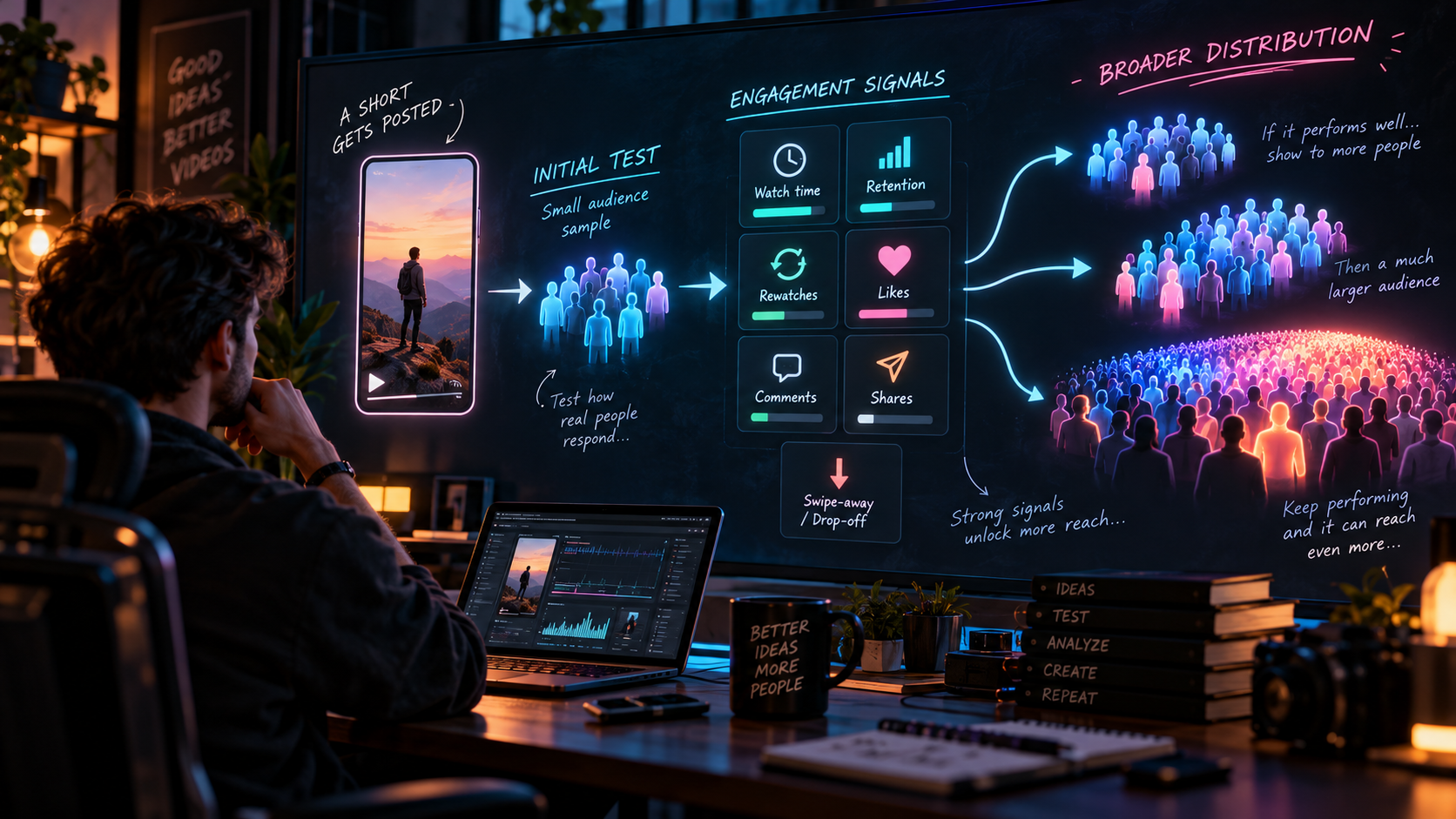
A better mental model is that recommendation feeds are constantly sampling audiences. The platform finds people it believes might like a video, puts the video in front of them, watches what they do, and uses that response to decide who else should see it. If the signals are strong enough, the potential audience expands. If the response is weak, distribution can slow. If the system later finds a better audience match, the video can move again.
That does not mean TikTok or YouTube publishes a rule saying every video gets exactly 500 viewers in Round One, 2,000 in Round Two, and 10,000 in Round Three. They do not. There is no public universal “pass this retention rate and unlock the next batch” formula.
But both platforms are unusually clear about the underlying ingredients: who the viewer is, whether they choose the video, how they watch it, and whether the experience appears to satisfy them.
Once you start thinking in those terms, a lot of seemingly random behavior starts making more sense.
The feed is trying to answer a prediction problem
When you open TikTok or the YouTube Shorts feed, the platform does not need to identify the single best video on the internet. It needs to predict the best next video for you.
That distinction matters.
TikTok says its For You system ranks videos using signals that include user interactions, information about the video, and account or device settings. It also says stronger expressions of interest can receive more weight than weaker ones. Its own example is that finishing a longer video can be a stronger signal than something like the viewer and creator being in the same country. How TikTok recommends videos
YouTube describes the same problem in slightly different language. For content performance, it groups signals into three broad buckets: appeal, engagement, and satisfaction. Did someone choose to watch? Once they started, did they stay? Afterward, did the experience appear to be satisfying? YouTube recommendation performance
For Shorts specifically, YouTube says it looks at whether viewers choose to watch or swipe away, average view duration, average percentage viewed, likes, and post-watch survey results. It combines that performance with personalization — what that particular viewer has watched before, the topics they like, and other signals about what they are likely to enjoy. YouTube Shorts search and discovery
That is why I think “sampling” is a more useful word than “pushing.”
The platform is not just handing out views. It is gathering evidence.
The first test is not random
The phrase “test audience” can make it sound as if TikTok grabs 500 random humans and waits to see what happens. That is not how the platforms describe their systems.
The entire point of recommendation is matching.
TikTok says your For You feed is personalized around what you watch, like, share, search for, comment on, and follow. Its current Help Center can even explain why an individual post showed up — for example, because you interacted with similar posts, because the content is popular in your country, because it is recent, or because you tend to watch longer videos. TikTok For You Help
YouTube says its recommendation system similarly tries to understand both a viewer’s history and their topic affinities. In Shorts, it looks at the Shorts and channels someone has enjoyed before, the subjects they watch, and even sounds or trends they have interacted with. YouTube recommendation system
So when I say a platform “samples” a video, I mean it is putting that video in front of some group of people it currently believes could be a reasonable match, then learning from what those people do.
That distinction explains something creators see all the time: the same piece of content can perform very differently with different audiences.
A joke about AI video generation may be fantastic for people who spend all day using video models and completely meaningless to someone whose feed is mostly college football. A surreal found-footage clip might confuse one audience and generate rewatches from another. The content did not change. The audience fit did.
The recommendation system is trying to solve both sides of the equation at once.
The swipe is already engagement
Creators tend to hear the word “engagement” and think likes, comments, shares, and follows. Those matter, but in short-form feeds, the engagement decision starts before any of them.
The first decision is whether the viewer stays.
On YouTube, this is visible directly in Shorts analytics as “How many chose to view” versus swiped away. YouTube also gives creators a “Shown in feed” metric, which is particularly useful because it separates the opportunity to be seen from what viewers did with that opportunity. YouTube Shorts analytics
That is one reason the first second or two of a short-form video matters so much. Before someone can like the video, finish it, replay it, comment on it, or share it with a friend, they have to decide not to leave.
Then the platform gets another layer of evidence: how long they stayed.
A ten-second video watched for nine seconds tells the system something. A ten-second video watched twice tells it something else. A sixty-second video abandoned after four seconds sends a very different signal from one finished to the end.
TikTok has publicly described full watches as a strong indicator of interest. YouTube explicitly uses average view duration and average percentage viewed when evaluating Shorts. Neither platform says there is one magic retention number that guarantees expansion, and my own experience gives me no reason to believe there is one.
The important point is that watch behavior is engagement. A viewer does not need to touch a button to cast a vote.
Likes are useful. Satisfaction is bigger than likes.
This is another place where creator shorthand can get misleading.
A video with a high like rate feels successful because likes are visible. But recommendation systems have access to much more information than the public counter under the video.
TikTok says it uses interactions including likes, shares, comments, follows, watches, searches, and negative feedback such as indicating that you are not interested. YouTube includes likes and dislikes, “not interested” feedback, “don’t recommend channel,” watch history, and satisfaction surveys among its recommendation signals. Why TikTok recommends a video · How YouTube recommendations work
In other words, a like is one piece of evidence inside a much larger behavioral picture.
Imagine a 15-second video that people watch twice but rarely like. Now imagine another video that earns a decent like rate but loses half the audience in the first second. Which one should receive more reach?
There is no public formula that lets us calculate the answer, and the answer may not even be the same for every viewer. But this is exactly why reducing performance to a single metric is dangerous. Recommendation systems are not grading videos on one score. They are trying to predict satisfaction.
That also helps explain why some videos with apparently great creator-facing metrics still stop moving. We only see part of the evidence.
Expansion is really the system becoming more confident
The familiar creator description is that a platform gives a video a small test, then a larger test, then another larger test. I think that model is directionally useful as long as we do not turn it into fake precision.
The exact mechanics are not public, but conceptually the platform is updating its confidence.
Suppose a new TikTok is initially shown to people who frequently watch found-footage comedy. They stop scrolling, watch most of it, some replay it, and enough of them share it that the system receives strong evidence of audience fit. The platform now has a reason to look for more people with similar interests.
That next audience may be broader. It may include adjacent interest groups. It may contain people whose viewing histories only partially resemble the first group. Each expansion creates more evidence.
Eventually, one of several things can happen. The video may keep finding receptive audiences and continue expanding. It may exhaust the audience most interested in the premise. It may reach a broader group that responds less strongly. Or competition from other content may make the same performance less valuable at that moment.
YouTube explicitly lists topic interest, competition, and seasonality as outside factors that can affect how many people see a Short. A video can have good metrics and still receive fewer impressions if other Shorts competing for the same viewers are performing better. YouTube Shorts search and discovery
This is why “my metrics were better than the last video, so this one should have more views” is not always a valid conclusion.
The test is not happening in a vacuum.
This also explains the weird delayed winners
Sampling is particularly useful as a mental model when a video comes back from the dead.
I have seen this on my own YouTube channel. A Short can receive almost no meaningful Shorts Feed exposure, sit there looking finished, and then suddenly start moving later. One of my clearest examples eventually reached roughly 18,000 to 20,000 organic views after initially looking like an upload YouTube had barely tested at all.
Once it did receive meaningful distribution, its audience response was excellent: roughly a 74% stayed-to-watch rate and average percentage viewed around the 170% range.
The video had not changed. What changed was the opportunity to collect enough audience response.
That is why I now separate allocation from performance. If a video is shown to thousands of appropriate viewers and they reject it, I have learned something about the creative. If it barely enters the feed, I have learned much less.
YouTube itself makes that separation visible by reporting both how often a Short was shown in the feed and how often viewers chose to watch it.
TikTok feels different in my own publishing experience because it more consistently seems to give each upload an initial opportunity to collect audience data. YouTube Shorts can go through stretches where that initial allocation becomes much less predictable. That was the subject of another JVR article, but the underlying principle is the same: you cannot evaluate response until there has been enough distribution to produce a response.
There is no universal pass line
This is where creator advice often becomes mythology.
“Get 70% retention and TikTok will push you.” “Hit 80% viewed versus swiped and YouTube gives you the next batch.” “Ten percent likes means the video goes viral.”
Those rules are appealing because they turn a complex prediction system into a scoreboard. Unfortunately, the platforms do not describe their systems that way.
TikTok says signals are weighted and combined to rank content for individual users. YouTube says Shorts ranking incorporates personalization, appeal, engagement, satisfaction, topic demand, competition, and other contextual factors. YouTube also says the system evaluates each piece of content individually, and that one underperforming video does not automatically penalize an entire channel. TikTok recommendation system · YouTube Shorts search and discovery · YouTube recommendation guidance
So the same 70% retention rate can mean different things on a seven-second joke, a 45-second story, and a 90-second tutorial. It can mean different things for a broad comedy premise than for a niche software demonstration. And it can mean different things depending on which viewers received the video in the first place.
Benchmarks are still useful. I use them constantly. But they are diagnostics, not unlock codes.
The creator’s job is to make the next sample easy to understand
Once I started thinking about feeds this way, my creative decisions became simpler.
The opening has one job: make the right person understand quickly enough that they should stay. The body has another: keep fulfilling the promise that made them stop. The ending should reward the time they spent, whether that reward is a punchline, reveal, answer, emotional beat, or something worth replaying.
Likes, comments, shares, follows, and rewatches are all useful because they provide additional evidence that the viewer got something from the experience. But none of them can rescue a video that the intended audience never understands.
This is also why clear premises often outperform clever but confusing ones. The recommendation system has to learn who likes the video, and the viewer has to decide whether to stay, in a remarkably small amount of time.
Confusion adds friction to both jobs.
Reach is the result, not the input
The biggest change for me is that I no longer think about reach as something the platform simply grants.
Reach is the output of a repeated prediction loop. The system picks viewers. The viewers respond. The system updates its prediction. Then it decides where the video belongs next.
Sometimes that process produces 400 views. Sometimes it produces 400,000. Sometimes it stops and restarts later. Sometimes a video performs well but runs into limited topic demand or stronger competition. Sometimes, particularly on YouTube Shorts in my experience, the video barely gets enough initial feed exposure to tell me much of anything.
From the outside, all of those outcomes get compressed into one number underneath the video.
That is why views alone can be so misleading.
The more useful questions are: How much opportunity did the video receive? Who appears to have received it? Did they choose to watch? Did they stay? Did they seem satisfied? And did the platform keep finding more people who behaved like them?
That is the machinery hiding underneath the FYP.
Your video is not simply being pushed.
It is continually auditioning for the next viewer.