Everybody Stay Serious. This Documentary Is Completely Ridiculous.
How to make absurd AI documentaries work by keeping the camera, characters, and world completely sincere.
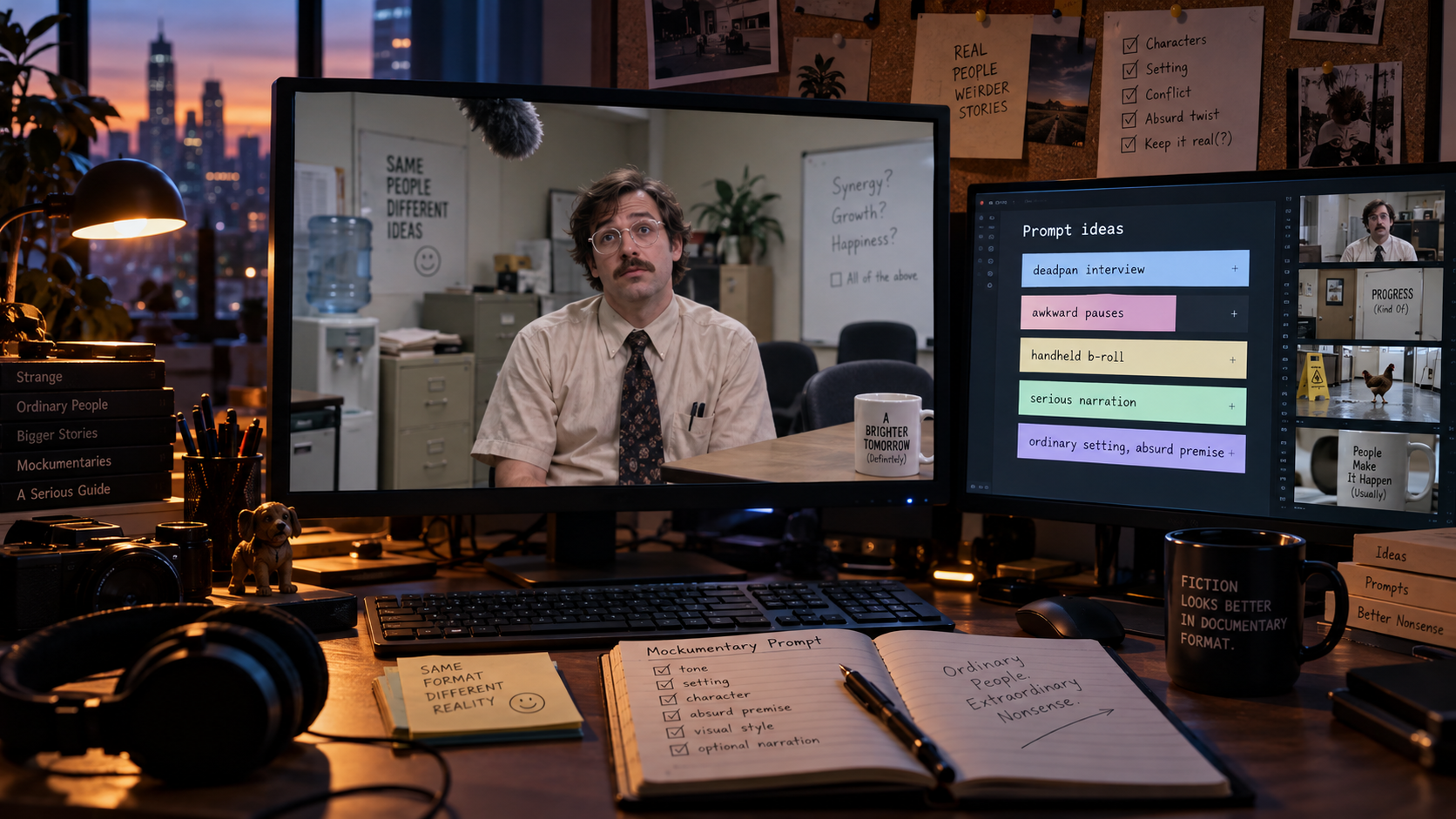
Good evening, Just Visiting Reality. V1nmon here, reporting from a regional sport stacking tournament, where a 41-year-old accountant is re-taping his wrists for the third time before attempting a personal best in competitive cup stacking.
He isn’t nervous. He’s preparing.
That attitude is a whole film. Give him a folding table, a timing mat, a coach who understands the discipline, and a crew willing to listen, and the cups become the least interesting thing in the room. We want to know how a person ends up like this. We want to know who sanded the rims. Some of us suspect we’d be very good at this.
That’s the territory for AI mockumentary: strange people and stranger obsessions, shot with enough conviction that the audience stops questioning the arrangement. The joke lands harder when the world keeps going after the punchline.
The MOCKUMENTARY CINEMATIC ENGINE runs on one rule:
THE DOCUMENTARY NEVER KNOWS IT IS FUNNY.
Tape it to your monitor. It will save you from a lot of footage of people grinning into the lens while plinky music tells you comedy is happening.
Everybody here has to drive home after
Both of these worlds are real. Competitive sport stacking has timing mats, sanctioned records and international championships. Competitive hobby horsing has show-jumping courses, judges and adults galloping stick horses over rails with perfect form. Nobody involved thinks they’re joking.
That’s your raw material. Now give somebody an ordinary problem.
The stacker worries his cups are wearing unevenly. The tournament coordinator worries the gym has to be cleared by four for a volleyball game. The hobby horse rider’s main concern is that Biscuit has been off his stride since the move to the new hall. Ordinary concerns give an unusual world somewhere to live.
That’s what the engine builds: what this world treats as normal, what its people believe, and what happens when they try to do the thing they’ve trained for. That gives the camera something to watch.
Back to the stacker. He shouldn’t see himself as a man with a strange hobby. Maybe he’s proud he’s never once used a non-regulation cup. Maybe he resents newcomers who think stacking is just a party trick. Attach a reasonable human feeling to an unreasonable situation and you have a performance you can direct.
Let the set carry the history. A shiny worn patch on the timing mat where his hands always land. A cup sleeve with a strip of masking tape and his name in marker. A fellow competitor who walks past his table without breathing near it. Skip the six paragraphs on the founding of the sport. Show us what eleven years of practice looks like at table height.
Decide who brought the camera
Before you type “cinematic mockumentary,” decide who’s filming and what they think they came to see.
A local news crew might be covering the tournament as a fun Saturday segment. A club documentary might already know the stackers by name. A prestige profile might treat the accountant as a monument to human focus. Each one is a different film.
The local crew wants a clean explanation and a couple of usable shots. The club crew lets an argument about cup wear run because they’ve heard it before. The prestige crew gives this man a gorgeously lit interview while he describes the emotional toll of shaving three tenths of a second off his cycle.
Any of them can work. Pick one and obey its logic.
Once you’ve picked, prompting gets easier. You have a reason for the lighting, a reason for the interview, and a reason to cut away. You also know which tempting shots to skip. A drone sweeping over the stacking tables raises questions about the local station’s insurance, and the gym’s.
Credibility doesn’t require ugly pictures. A formal interview can be beautifully lit. What matters is whether the production choices make sense for this crew, in this place, on this story.
Let the camera be a little late
A competitor’s tower collapses at the table behind the interviewee, and the camera is already framed perfectly on the scattering cups before the first one moves. That reads as staged, because the operator apparently gets advance notice from the universe.
Give the crew a human sequence: hear it, notice it, turn. Maybe they miss the first cup hitting the floor. Maybe the interviewee keeps talking while the operator decides the background is more interesting.
That small delay is proof something happened in front of a camera.
Use it sparingly. An operator who loses focus every two seconds needs an eye exam, and the audience can’t discover what it can’t see. The footage should be mostly competent, flawed only where real events force it.
Instead of “shaky handheld documentary aesthetic,” write: “The operator holds on the coach until cups clatter behind her, then reframes slightly right to include the stacker.” Now the movement has a purpose, and you can check whether that purpose survived generation.
Mind the geography. Put the stacker where the camera can already see or could plausibly turn. Don’t stage a collapse across the gym followed by a magic close-up in the same unbroken shot. The crew has feet. Make them walk over.
Every interviewee has a version of events
People on camera are usually trying to establish something about themselves: competence, authority, how calm they are about the thing that is clearly eating them alive.
That’s where the tension between interview and footage comes from.
A coach says her stacker doesn’t get nervous anymore. Behind her, the camera shows him peeling off his wrist tape and starting over. Nobody performed a joke. You handed the audience two facts that refuse to sit together.
Keep the claim short so the image has room to answer it. Run the interview audio over the observed action and return to the face only when something happens there. A held expression can do more than the next sentence.
Not every interviewee should be a liar. People can be sincere and wrong, partly right, or fully aware of the problem with no power to fix it. The stacker’s teenage rival might be faster and calmer than him and completely uninterested in the cups’ history. That keeps people watchable past the first contradiction.
You don’t need an interview in every scene, either. One overheard instruction, “Don’t touch his cups, they’re broken in,” can set up the whole situation. Stay on the person who quietly steps back from the table and see how much story is already there.
Give the actor something smaller to do
Here’s an instruction that sends a scene straight to the comedy ER: “He reacts hilariously.”
What is that, physically? A grimace? A scream? A little dance? You’ve handed the performance to a word that covers half the internet.
Try this: he fumbles a cup, opens his mouth to swear, sees the judge watching, and quietly restacks.
Now there’s a decision. We see what he wanted and what he chose instead. Nobody has to sell the punchline.
For awkwardness, try a reply that lands a beat late, a hand hovering over the cups after the timer has already stopped, or a competitor bib straightened that was already straight. Pick the one that belongs to this person. Stack every nervous tic into one prompt and you get a malfunctioning dashboard.
A look to camera can work, but it needs a motive. The subject might be checking whether the crew caught the fumble, or silently asking for a second attempt. A reflexive “can you believe this?” glance after every absurd beat wears out fast.
And let people finish thinking. If your fifteen-second clip has thirty seconds of dialogue, you’ve assaulted the editor before the footage exists.
Escalation needs its own rulebook
Once the audience understands that the cups are sacred, complications can grow out of it. A rival’s cups turn out to be slightly lighter. Someone files a protest. A tournament official produces a kitchen scale.
On the hobby horse side, a rider’s horse is disqualified for an unregistered bridle change, and the appeal hinges on whether a ribbon counts as tack.
Every development follows the same internal logic, so the audience gets the pleasure of seeing the next problem coming.
If a meteor lands on the stacking table halfway through, it needs a reason that belongs to this world. Surprise alone has a short shelf life. Twelve plastic cups can carry an entire scene if the people around them care enough.
For ten or fifteen seconds, be ruthless: one confident claim, one action that undercuts it, one moment afterward. A longer film can follow the protest through the weekend, add a competing interpretation, and let yesterday’s fix become today’s problem.
Give the final beat room. People getting back to their next round after something ridiculous tells us it’s an ordinary Saturday, and that’s often where the scene becomes most convincing.
Leave the gym hum alone
Sound gives a location life that doesn’t depend on dialogue. The ventilation keeps running. Cups clack at the next table. The timing mat beeps somewhere off-screen and nobody looks up.
Those details make a pause feel inhabited. Without them, a held reaction can feel like the video froze.
Start with what the crew would actually record. If the form calls for music, give it a deliberate job. A prestige sports profile can earn an earnest score. A club observation might need nothing but room tone and the squeak of sneakers on a varnished floor.
Skip the comedy sting under the cups. We can see the cups. They’ve done enough.
Edit with the same confidence. Cut to show evidence, expose a relationship, or catch a reaction. Hold while the subject tries to recover. Staying half a beat longer than the character would like makes an audience squirm, but only if something worth staying for is happening.
The master prompt
The engine turns your premise into a documentary world, scene beats, and a prompt for your video model. Give it the core idea and the details you care about. You shouldn’t have to draft a sanctioning body’s rulebook to get a fifteen-second clip.
Below is a reusable brief for the MOCKUMENTARY CINEMATIC ENGINE. Fill in the brackets and paste it into a chat where the engine is available. The article can be loud. The generation instructions stay precise.
Use the MOCKUMENTARY CINEMATIC ENGINE to develop this premise:
[YOUR PREMISE]

Runtime: [EXACT SECONDS]
Documentary form: [WORKPLACE / LOCAL NEWS / PRESTIGE PROFILE /
SPORTS / INVESTIGATIVE / ARCHIVAL / OTHER]
Setting: [LOCATION AND IMPORTANT PHYSICAL DETAILS]
Main subject: [WHO THEY ARE AND WHAT THEY SINCERELY WANT]
The contradiction: [WHAT THEY BELIEVE OR CLAIM, AND WHAT WE SEE]
Must keep: [CHARACTERS, HANDLES, REFERENCES, DIALOGUE, OR FINAL BEAT]
Target video model and available controls: [IF KNOWN]
Aspect ratio: [IF KNOWN]
Sound preference: [DEFAULT TO REALISTIC LOCATION SOUND]

The documentary never knows it is funny. Everyone inside the scene
believes in the situation. Build humor from behavior, evidence,
social pressure, and consequences. Let the audience discover it.

Establish one clear rule for this world. Preserve my premise and
approved choices. Add only what the scene needs. Ask a focused
question if a missing choice would fundamentally change the idea;
otherwise state your assumptions briefly and proceed.

Give the crew a believable reason to be there. Use one consistent
documentary language. Put the camera somewhere physically plausible.
Let it react after an unpredictable event begins, with mostly competent
framing and small, motivated imperfections.

Direct sincere performances using specific visible behavior.
Use interviews only when they contribute. Let observed footage
support, complicate, or contradict what the subject says.

Keep the action causal and achievable within the runtime. Leave time
for reactions and the final beat. Keep dialogue economical and clearly
attribute each important line to CHARACTER / ROLE — context.
Distinguish secondary and off-camera speech.

Preserve character appearance, wardrobe, props, geography, lighting,
screen direction, and physical state through cuts. Use location sound;
add music only if requested or explicitly agreed for this concept.

Return:
1. A short scene premise, the world's rule, and the central contradiction.
2. A timed beat sheet adding up to the exact runtime.
3. A generation-ready prompt using:
   Style
   Duration
   Scene / Setting
   Cinematography
   Mood
   Characters
   Actions
   Dialogue
   Sub-Dialogue, when needed
   Background Sound
   Final Beat

Keep the final prompt concrete and economical. If the target model
cannot fit the scene into one generation, supply separate shot prompts
and a simple edit plan. Flag unknown capabilities rather than inventing
them. Check timing, continuity, speaker identity, camera plausibility,
and whether the ending gives the audience room to understand the joke.
You can keep refining with the engine before you generate. “The coach is too smug; make her sincerely proud” is a useful note. So is “Keep everything else, but let the camera find the jump later.” You’re adjusting one directorial choice. You don’t need to burn the whole scene down and start over.
Put it to work: the blue jump
Here’s an untested example from the hobby horse world, kept deliberately small so we can see whether the core idea holds up.
Style: Sincere local-news sports feature. Ordinary digital documentary footage, natural color, a small crew covering a regional hobby horse show.
Duration: Exactly 15 seconds.
Scene / Setting: A community sports hall set up as a show-jumping course. The coach stands foreground left. About eight meters behind her, frame right, a low practice jump is draped with a blue tarp to represent water. The rider waits at the far end of the hall holding a hobby horse: a wooden stick with a brown plush horse head named Biscuit. Painted court lines, folding chairs along the wall, bright overhead gym lighting.
Cinematography: One continuous medium-wide handheld shot from the side of the course, approximately a 35mm full-frame-equivalent view. Keep the coach and the blue jump readable in the same frame. Hold on the coach initially. When the rider starts her approach, reframe slightly right to follow her. Mostly steady camera, one modest adjustment, sufficient depth of field for both subjects.
Mood: The coach is proud and confident. The rider is focused, treating the horse with real care.
Characters: Coach in her 40s, team fleece and lanyard, clipboard. Rider in her 30s, riding helmet, black athletic leggings, numbered competitor bib. Maintain their appearance, the hobby horse, and the established room layout.
Actions: 0–4 seconds: the coach speaks to an interviewer beside the lens. 4–8 seconds: the rider gallops toward the blue jump in a smooth, practiced stride, then stops dead just before it, leans down and pats the horse’s neck. 8–12 seconds: she trots a small circle, approaches again, and clears the jump cleanly. 12–15 seconds: the coach glances toward the jump, looks back to the interviewer, and waits. The rider gives the horse one more pat.
Dialogue: COACH — answering the interviewer at the start: “Biscuit’s completely over the blue jump.”
Background Sound: Gym ventilation, sneakers squeaking and thudding on the court floor, a faint murmur from spectators along the wall, a muffled PA announcement in another part of the hall. Only the specified spoken line; no music.
Final Beat: Hold the coach and the rider with her horse in the same frame. Cut at 15 seconds.
The rider does the refusal, not the horse, because a plush head on a stick can’t act. A sincere stop, a pat on the neck and a reset circle let her treat Biscuit’s nerves as completely real without anyone explaining it. The camera stays wide because the audience has to connect the coach’s claim to the jump behind her. The last three seconds let the coach go on being the person who just said that.
Watch the generation for those choices. If the rider mugs at the camera or makes a show of the refusal, pull the performance back. She should look like a competitor managing a horse. If the hobby horse starts moving on its own, regenerate. If the camera turns before she starts her approach, fix the timing. If the model invents a second line explaining the contradiction, cut it. If the action won’t cooperate in one take, generate the interview and the jump separately and build the relationship in the edit.
Biscuit doesn’t need to know we’re laughing. He has a course to finish. And over on the next court, a man is re-taping his wrists for the fourth time.